
If you’re trying to “drive adoption,” you’ve probably been tempted to do the obvious thing: mandate it.
I get it. Leadership wants to see AI wins. The pressure is real. So you roll out Copilot or another AI tool, tell everyone to use it, and hope the numbers go up.
Here’s the problem: forced adoption produces performative usage, resentment, and fast abandonment. People log in once to satisfy a quota. Then they stop. You’re left with a dashboard that looks good and adoption that doesn’t stick.
There’s a better way. Adoption is earned when AI reduces effort inside the workflow people already use. You don’t need users to believe in AI. You need AI to remove one real pain point from their day.
Let me show you how.
This isn’t about the quality of the tool. Copilot, ChatGPT, Claude—they’re powerful. The failure happens at the adoption layer.
People don’t have extra time to learn a new workflow. Their inbox is full. Their calendar is packed. Asking them to “go try the new AI tool” is asking them to add work, not remove it.
Switching contexts creates friction. Chat windows, separate portals, “go ask Copilot”—every time they have to leave what they’re doing to interact with AI, you’ve added a step. And steps get skipped when people are under pressure.
Trust is fragile. One wrong answer can poison perception. If AI hallucinates a number in a report or suggests something that breaks a process, people remember. They stop trusting. And without trust, adoption dies.
Incentives are misaligned. Leaders want usage metrics. Users want relief. When those don’t match, you get surface-level compliance, not real behavior change. Research from Nielsen Norman Group backs this up: users hate change, and they resist when it feels imposed.
Treat adoption as a delivery system, not a comms campaign. Here’s a four-stage model that actually works.
Time saved or cognitive load reduced is measurable. You have a before/after number or a clear “this used to take X, now it takes Y.”
Don’t start with “we’re rolling out Copilot.” Start with “what task should become easier?” Define the job-to-be-done. Is it triage? Summarization? Drafting replies? Translation? Pick one high-volume job with clear pain.
Integrate AI into the workflow. Reduce clicks. Reduce steps. Reduce decisions. The goal is for AI to appear where the work already happens—not in a separate window people have to remember to open.
Add guardrails. Be transparent about what AI can and can’t do. Use human review where the stakes are high. Make “what it can’t do” explicit so people know when to double-check.
Training. Champions. Lightweight feedback loops. Small iteration cycles. Adoption doesn’t sustain itself. You need a path for people to learn, get unstuck, and see that it’s working.
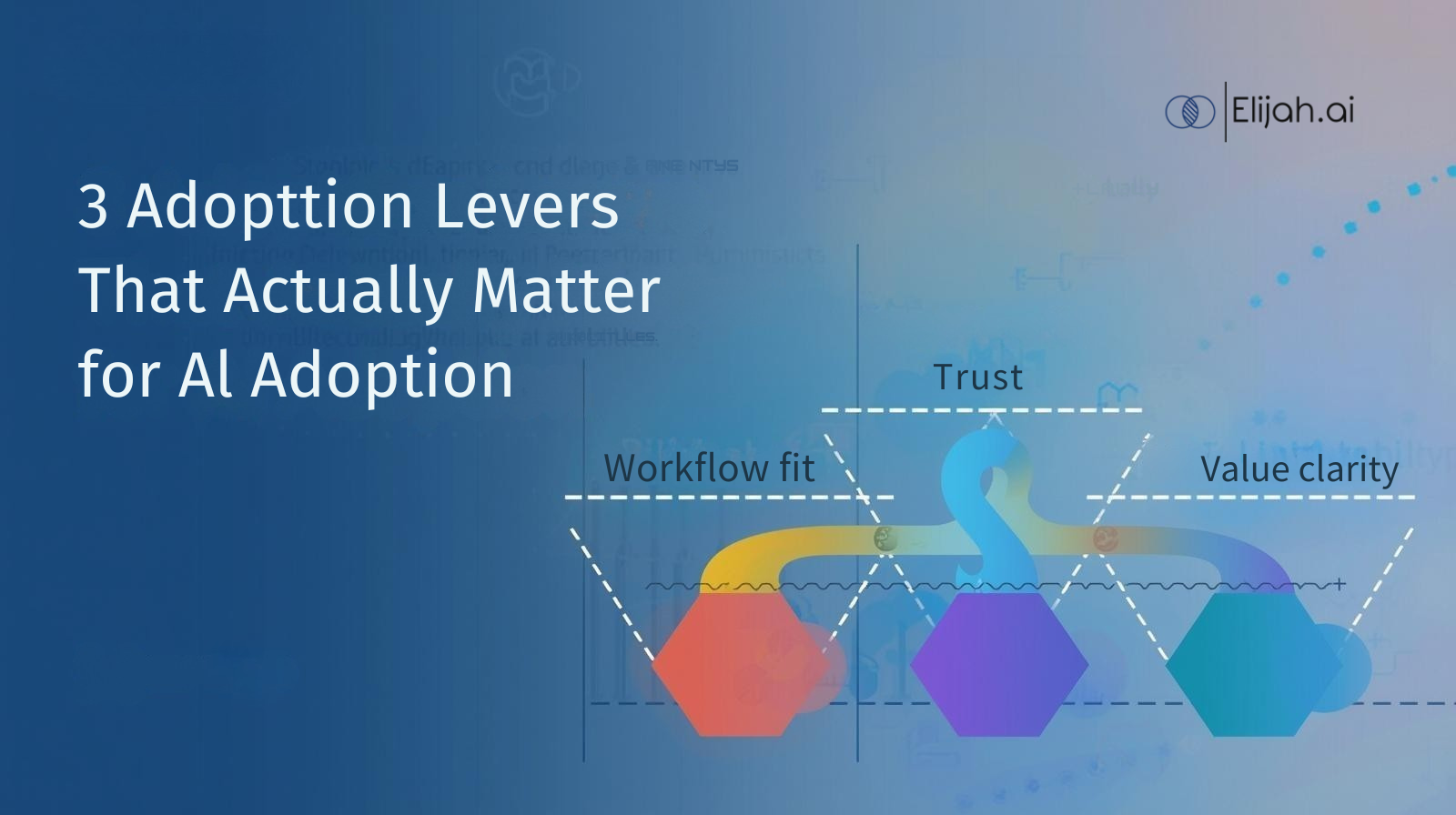
Three levers move the needle. Get these right, and adoption follows.
Where does AI appear in the existing workflow? What does it eliminate? If the answer is “nowhere” and “nothing,” you’re building the wrong experience.
What decisions can AI suggest versus decide? Who reviews output in higher-risk scenarios? The more consequential the output, the more human oversight you need. Start strict. Loosen as trust builds.
What metric improves? Cycle time? Errors? Deflection? Quality? Who owns it? If you can’t measure relief, you can’t prove adoption is working. And if no one owns the metric, it won’t get attention.
Microsoft’s Power Platform adoption guidance offers a solid backbone for thinking through adoption at scale—even if you’re not using Power Platform for the AI itself.
Example 1 (Pass): AI summarization embedded in an existing triage workflow. Each person saves 10 minutes a day. A human reviewer signs off on final decisions. The job is clear. The workflow is integrated. The metric is measurable. Pass.
Example 2 (Pause): “Everyone must use Copilot daily.” No clear job-to-be-done. No workflow integration. No measurement. This becomes performative usage fast. People open it, type something, close it. Pause—until you have a specific job, integration, and a way to measure relief.
Here’s what it looks like when a team pivots from mandate to earn-it.
Starting point: Leadership wanted AI “everywhere.” Teams were overloaded and skeptical. The mandate was clear. The adoption wasn’t happening.
Pivot: Instead of mandating usage, they standardized intake for AI ideas. They picked one high-volume job with clear pain—document triage for a shared inbox. They defined the job, integrated summarization into the existing workflow, and added a human reviewer for final decisions.
Pass/Pause decisions: Risky use cases (e.g., AI generating financial summaries without review) were paused until guardrails and review roles were defined.
Enablement: They created lightweight training and a champion path. Adoption didn’t depend on one power user. When someone got stuck, they had a place to go.
Measurement: They tracked one simple KPI tied to relief: cycle time for triage. Not “number of prompts.” Not “logins.” Cycle time.
Outcome: Usage grew because the workflow got easier. Not because anyone was forced. Prosci’s work on resistance management explains why mandates backfire; the ADKAR model offers a framework for change that sticks.
If you have to force adoption, the experience is wrong.
Your next step: Pick one job. Integrate AI into the workflow. Measure relief. Do that before you worry about scaling.
Adoption isn’t commanded. It’s earned.