
If your Power Platform program is growing, you’ve felt this tension.
You need to move fast, but without breaking things.
You want to innovate, but without compromising security or compliance.
For Admin Leads, the priority is safeguarding the tenant: enforcing governance, protecting data, and maintaining a strong compliance posture.
For Delivery Leads, the mission is speed. They’re focused on delivering value quickly without getting bogged down in approvals or red tape.
This is where a Center of Excellence (CoE) makes the difference.
Not as a slow-moving committee.
Not as the “no” team.
But as an enablement engine that helps teams deliver faster, safer, and more consistently at scale.
In plain language, a Power Platform center of excellence is a small set of capabilities that help your organization scale Power Platform adoption without sacrificing quality, security, or delivery speed.
It is nota single org chart.
It is nota static team.
It is a way of working.
At its best, it creates three outcomes:
Keep it grounded in Power Platform reality:
Most teams land in one of these models. None is universally “best.” The right one depends on maturity, risk, and how much demand is coming from the business.
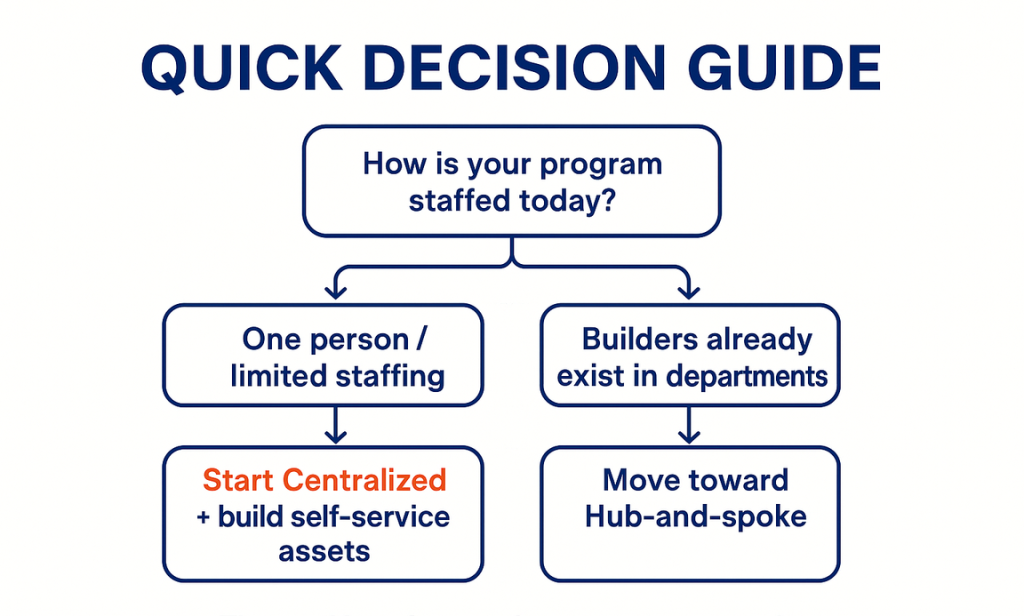
Everything routes through one core team.
A small core sets standards and guardrails. Delivery happens within departments.
A hub defines standards, guardrails, and shared services. Spokes deliver inside business areas.
If you can only staff one person, start closer to centralized, but bias toward self-service assets.
If you already have builders embedded in departments, move toward hub-and-spoke as you mature.
A center of excellence is often the right move when:
If you’re early, you don’t have to “go big” to start.
You can start lightweight and still be serious: a few guardrails, a few reusable assets, and a way to see what is happening in your tenant.
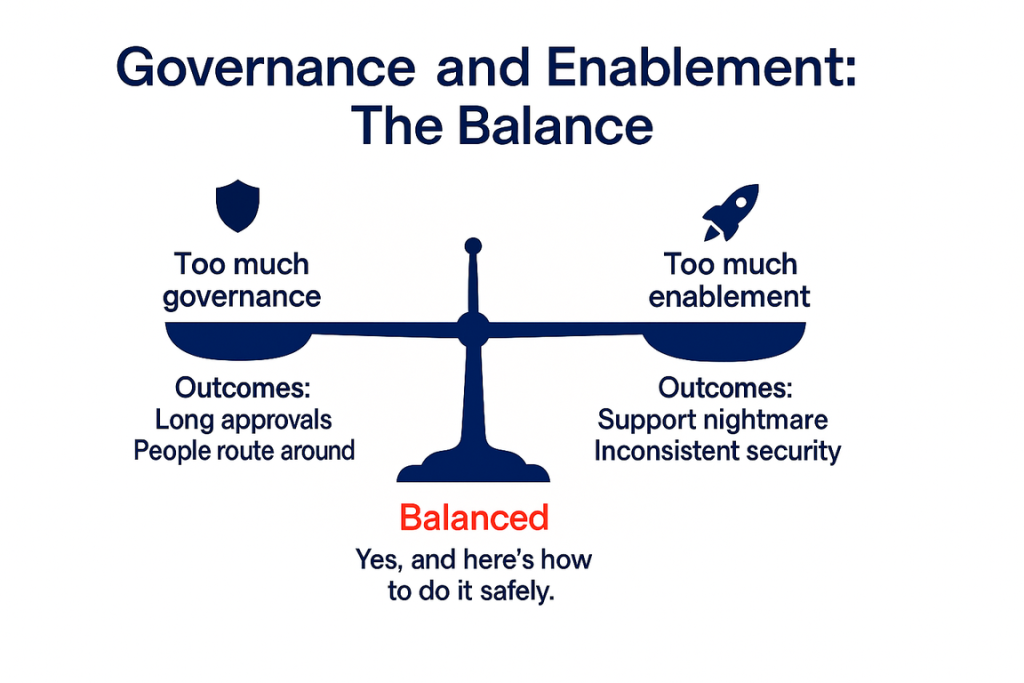
I like to frame it this way:
Enablement is empowerment for builders.
Governance is protection for the organization.
The operating principle you’re aiming for is simple:
“Yes, and here’s how to do it safely.”
Governance is not there to slow people down.
Governance is there to make the safe path the fast path.
The balance is guardrails, templates, and clear lanes for different types of solutions.
Here’s the mindset shift that makes the balance real without turning you into a bureaucracy.
You are not trying to control every build; you are trying to reduce surprises.
If you do that, you get both outcomes:
A practical way to think about it:
The goal is not perfect governance on day one, rather, a system where you can say “yes” more often, without waking up to a bigger mess next month.
This is where you decide where work happens, and where it is not allowed to happen.
When the environment boundaries are clear, you can move faster because you are not renegotiating the basics every time.
Microsoft’s guidance is basically this: most organizations start in the default environment, and that’s fine for early productivity work. As adoption grows, the default environment is not where you want “everything forever.”
You need a strategy that routes makers into the right place so governance and security can be applied consistently, without you manually policing every new app and flow.
Develop a tenant environment strategy to adopt Power Platform at scale
Example in real life:
you stop building directly in production.
This is where you make work visible and defensible.
It’s how you say yes without saying yes to everything.
This is also where you protect your future self.
When you validate the request up front, you avoid building the wrong thing quickly. When you prioritize in the open, you stop getting cornered by whoever escalates the loudest.
Example in real life:
requests stop arriving in five different places, and you can explain why you said yes to one thing and not another.
This is the delivery lifecycle.
It’s how you stop “shipping” from meaning “hoping.”
The goal is not to slow delivery down.
The goal is to make delivery repeatable so you can ship twice without paying twice.
When this phase is consistent, you get fewer late-night surprises and fewer “who changed what?” conversations.
Example in real life:
releases become boring, which is the goal.
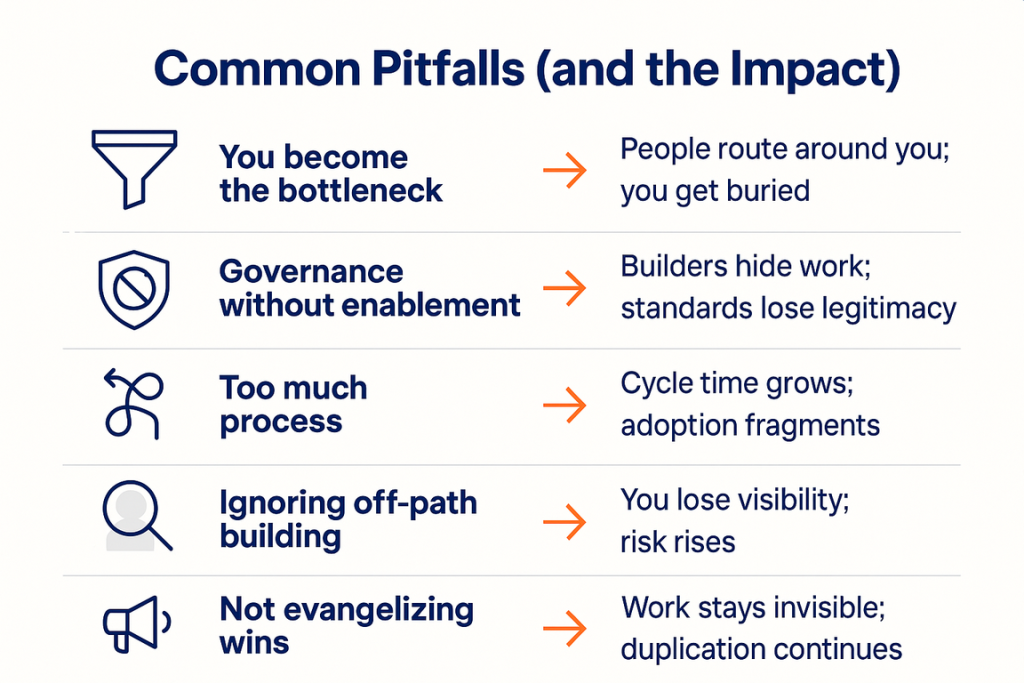
Support is how you keep trust when something breaks, and how you keep today’s success from turning into next month’s resentment.
Reporting and evangelization are how you keep your wins from disappearing.
They help people find what already exists, follow the safe patterns, and stop rebuilding the same solution three different ways.
If your wins stay invisible, demand doesn’t get easier. It gets louder. And you stay buried.
If you are serious about day-one visibility, consider implementing thePower Platform Center of Excellence Starter Kit early.
Resources:
Microsoft overview/documentation for the Power Platform Center of Excellence Starter Kit
GitHub repository for the Power Platform Center of Excellence Starter Kit
Direct install/download instructions for the Power Platform Center of Excellence Starter Kit
Data loss prevention policies and connector governance
Application lifecycle management with solutions and environment promotion patterns
When you are building from scratch, return on investment is not the only metric that matters.
Momentum matters.
Here are quick wins that do not corner you:
If you want a simple next step for this month:
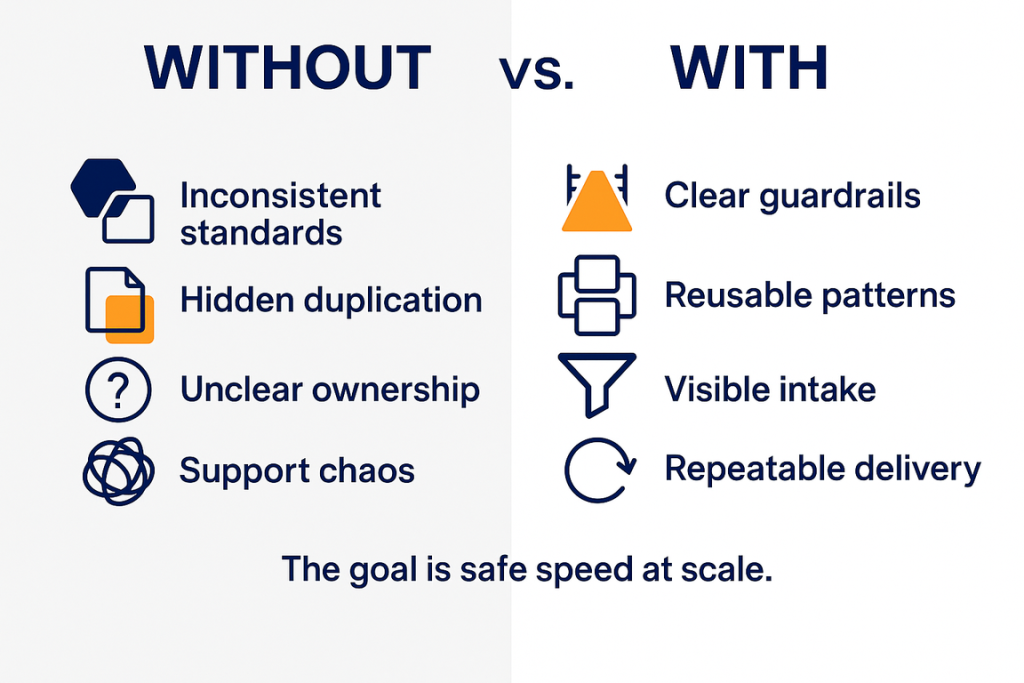
A Power Platform center of excellence is not about control. It is about repeatable delivery at scale.
If it slows delivery, people will route around it.
If it enables safe speed, it becomes the foundation that lets you scale without burning out.
If you want to talk through what this looks like in your world, feel free to email me.